
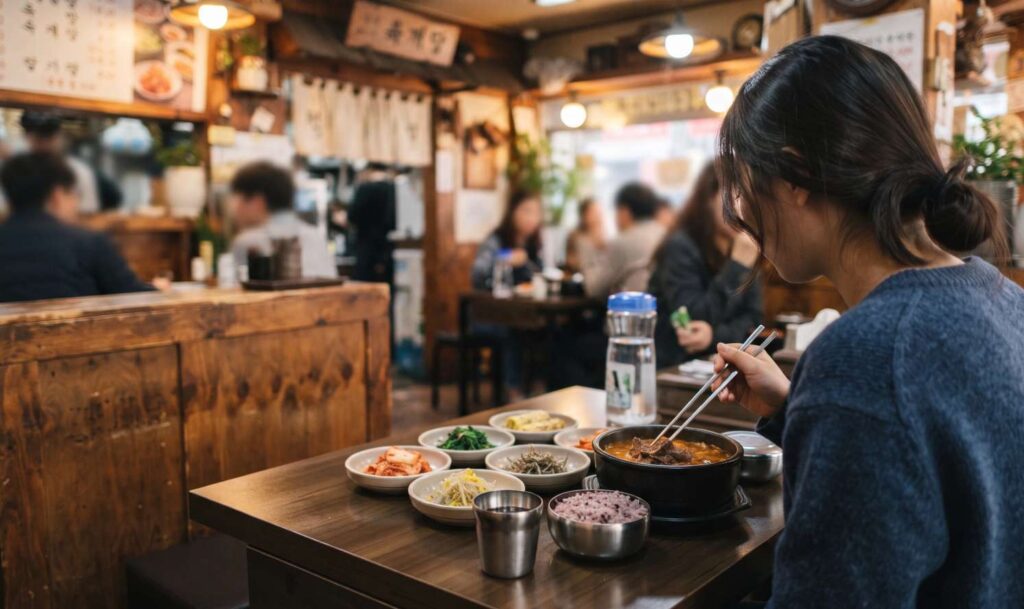
Picture a counter where every seat faces the wall, a kiosk that takes your order with a few taps, and a bowl of hot noodles arriving two minutes later. Nobody asks who you are with. Eating alone in Korea is not only possible, it now has its own word, and this guide shows you where to do it comfortably.
The short answer: yes, you can eat alone in Korea, but the type of restaurant matters a lot. Noodle shops, rice-bowl places, gimbap chains and markets welcome one person. Group-style restaurants, especially barbecue, may not. Here is how to tell the difference, what to say and what to order.
Last updated: October 23, 2026. Restaurant rules and opening hours change, so check the current details on Naver Map or KakaoMap before you go.
What is honbap, and why does it exist?
Koreans call eating alone 혼밥 (honbap). It joins hon (alone) and bap (rice, and by extension a meal). A matching word, 혼술 (honsul), means drinking alone.
Traditionally, Korean food is built for sharing. Rice comes with many side dishes in the middle of the table, stews bubble for several people, and meat is grilled together. Eating is social, and an old greeting is literally “Have you eaten?” That is why a single diner can still feel unusual to some older people.
But life has changed. A CNN Travel account, as reported by the Korean outlet Asiae, says single-person households reached a record 36% of Korean households in 2024. A 2017 article from the Korea Economic Institute of America (KEIA) describes honbap spreading first among university students under job-market pressure. More solo diners means more restaurants designed for them.
Where one person is welcome
Think of it this way: if the dish arrives in its own bowl or tray, one person is usually fine. If it is cooked in the middle of the table for several people, expect a minimum.
Noodle shops and rice-bowl restaurants
This is the safest category. Knife-cut noodle soup (칼국수, kalguksu), dumplings, udon, deopbap (rice bowls with toppings) and set meals are all served per person. Menus are often short, which makes ordering fast. A visitor guide from iVisitKorea points to Myeongdong Kyoja, known for kalguksu and dumplings, as a place with a short menu that makes ordering quick.
Gimbap and snack chains
Casual chains such as Ssada Gimbap serve gimbap, ramen and tteokbokki (chewy rice cakes in spicy sauce). iVisitKorea notes that many branches are open late or 24 hours, though you should confirm hours for the branch near you. Nobody lingers over a long table here, so you will not feel watched.
Pot rice and solo hotpot
Some restaurants give each diner their own pot. The same guide lists Damsot, which serves individual pot-rice sets (sotbap), and Shabu Boat, where each person gets a personal hotpot. Busy hours can mean a wait, so arrive slightly early or late.
Solo barbecue
Regular Korean barbecue is the hardest to do alone. But a few places are built for one: Hongojib is described by iVisitKorea as a solo barbecue spot with self-order kiosks, private seating and an individual grill. Expect a quieter, more private meal than a lively group restaurant.
Markets
Traditional markets such as Gwangjang Market and Mangwon Market let you order small portions at your own pace, according to the same guide. Standing or sitting at a stall counter is normal there, and no one expects a group.
Unstaffed ramen shops
A 2022 report from the Asia News Network described a 24-hour, unstaffed self-service ramen shop near Jongno 3-ga Station in Seoul, opened in February 2021. You buy a packet at a kiosk, add noodles and seasoning to a paper container, and a machine adds hot water. The report said many seats face the wall, ideal for solo diners. That report is several years old, so confirm any shop is still open before planning around it.
Convenience stores are another easy fallback. Our Korean convenience store food guide covers what to buy and how to cook ramen in the store.
The “no solo diners” problem (honest version)
It is better to know this before you arrive. In May 2026, Asiae reported on a CNN Travel piece by an American journalist who said he was turned away twice in Seoul on a weekday around 1 p.m. He held up one finger and was told, in effect, no solo diners. The article did not name the restaurants or give the owners’ reasons.
Why might it happen? The article does not say, so this is a reasonable guess rather than a verified fact: at lunchtime, a restaurant with large shared tables or a group-style dish may not want to give a table to one person. Barbecue and stew restaurants often price and cook for two or more.
The lesson is not that Korea dislikes solo travelers. It is to choose restaurants that fit one person, and to have a backup nearby.
Step by step: how to order alone
- Search smart. Type 혼밥 (eating alone), 1인 식당 (restaurant for one) or 1인분 가능 (one portion possible) into Naver Map or KakaoMap, plus a food type. For example, 혼밥 라멘 for solo ramen. iVisitKorea notes Korean searches often work better than English ones. Our essential apps guide explains both map apps.
- Look at the seating. Counters, small two-seat tables or a wall of single seats are a good sign. A room of large round tables and a grill in each is a warning.
- Enter and show one finger. Staff will often greet you and wave you to a seat. If not, say: 한 명이에요 (han myeong-ieyo), “It’s one person.”
- Check for a kiosk or tablet. Many solo-friendly places use them. Look for an English button, often in a corner of the screen. Pay there, take the receipt and sit.
- Order the set menu if unsure. Point at the picture and say 이거 주세요 (igeo juseyo), “This one, please.”
- Ask if a dish is available for one. Say 1인분 돼요? (il-inbun dwaeyo?), “Can I get one portion?” This is the single most useful question for stews and grilled dishes.
- Finish politely. When you stand, a small nod and 잘 먹었습니다 (jal meogeosseumnida), “I ate well,” is a warm way to leave. If polite speech levels confuse you, see our honorifics guide.
Easy first dishes for one
- Kalguksu (칼국수): hand-cut wheat noodles in a savory broth. Warming and filling.
- Deopbap (덮밥): rice topped with meat, egg or vegetables. A complete meal in one bowl.
- Dumplings (만두, mandu): often sold by the plate.
- Gimbap (김밥): seaweed rice rolls, good for a light meal or to take away.
- Set meals (정식, jeongsik): rice, soup and side dishes served per person.
- Tteokbokki (떡볶이): sweet-spicy rice cakes. Many snack shops serve one portion.
Some of these are covered in our autumn and winter street food guide, which also helps with stall ordering.
What is hard to order alone
These dishes are usually made for sharing, so ask first or save them for a friend:
- Regular Korean barbecue (고기집, gogi-jip), where the grill is shared and a two-person minimum is common.
- Army stew (부대찌개, budae-jjigae) and other big stews, which are often cooked at the table in a large pot.
- Whole chicken or large platters sold only in big sizes.
A common workaround, which travelers often mention, is to politely offer to order two portions. That costs more, so only do it if you want the food. Another is to look for lunch sets or pre-grilled meat bowls, which many restaurants offer in place of table-grilling.
Mistakes first-timers make
- Walking into a group barbecue place at peak lunch. This is the most likely time to be refused. Choose a noodle shop instead.
- Searching only in English. You will miss the best honbap spots.
- Waiting to be seated at a kiosk restaurant. In these places, you often order and pay first, then sit.
- Taking a big table at a busy time. Choose a counter or small table if you can; it is considerate.
- Giving up after one refusal. Take a breath, smile and move to the next place. It is rarely personal.
Insider tips
- Eat at off-peak times. Around 11:30 a.m. or after 2 p.m., staff have more time and tables are free, so a single seat is easy to give.
- Use the counter. Counter seats are made for one and are often the first to be free.
- Screenshot your order. Save the Korean name of the dish on your phone. Showing it avoids any pronunciation worry.
- Read the wall. Korean restaurants often show the menu on a wall board or photo menu. The first few items are often the house specialty.
- Try markets for variety. At Gwangjang or Mangwon, you can graze across stalls rather than commit to one big meal.
- Ask for takeout when stuck. 포장돼요? (pojang dwaeyo?) means “Can I take it away?” and many shops will say yes.
- Bring a phone, not a script. Many solo diners watch videos as they eat. It is a normal sight, so you can too.
A sample solo food day in Seoul
- Breakfast: gimbap or a convenience store meal.
- Lunch (just before the noon rush): a bowl of kalguksu or dumplings at a counter.
- Afternoon: market snacks, such as tteokbokki or warm street food.
- Dinner: a solo hotpot or solo barbecue place found by searching 혼밥 고기집 on Naver Map.
Check opening hours the same day. Small places can close between lunch and dinner or on a day off.
Quick answers
Is it rude to eat alone in Korea?
No. It is common, especially among younger people. Some older people may find it unusual, but nobody expects you to explain yourself.
Do I need to speak Korean?
Not much. Kiosks, photo menus and pointing work in many places. A few phrases help, such as 한 명이에요 and 이거 주세요.
Can I eat Korean barbecue alone?
Sometimes. Look for places that advertise solo seats, such as Hongojib, or for lunch sets. Regular barbecue restaurants may require two portions or two people.
What should I search on Naver Map?
Try 혼밥 plus a food word, or 1인 식당 and 1인분 가능.
Should I tip?
Tipping is not the norm in Korea, so you generally do not need to add anything. If a restaurant has a policy, it will be shown on the menu or bill.
Who this is best for
This guide suits solo travelers, students, remote workers and anyone new to Korea who wants a stress-free meal. If you would rather find a dining partner for the dishes that are best shared, ask in our Food & Dining community space or look for a friend in the Travel Buddies space.
What is the first solo meal you want to try in Korea? Share it in the comments.