
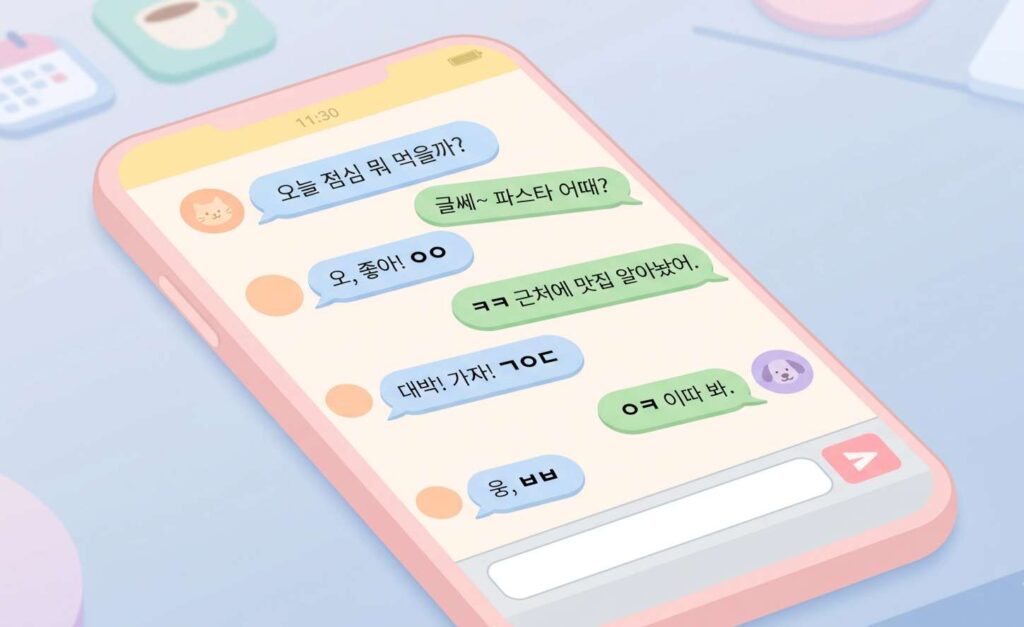
If you’ve ever looked at a Korean group chat and seen a stream of strange consonants like ㅋㅋㅋ or ㅇㅇ, you’re not alone. Korean speakers shorten words by typing only their first consonants, and the habit is everywhere on KakaoTalk, social media and comments.
Here are 15 abbreviations and slang words you’ll see all the time, with their meaning.
Consonant abbreviations
- ㅋㅋ / ㅋㅋㅋ (kk): laughing, like “lol.” More ㅋ means funnier.
- ㅎㅎ (hh): a softer, friendlier chuckle, like “haha.”
- ㅇㅇ: “yeah” or “yep” (short for 응, eung).
- ㄴㄴ: “no no.”
- ㅇㅋ: “OK” (short for 오케이).
- ㄱㅅ: “thanks” (short for 감사, gamsa).
- ㅈㅅ: “sorry” (short for 죄송, joesong).
- ㅊㅋ: “congrats” (short for 축하, chuka).
- ㄱㄱ: “go go,” as in “let’s go.”
- ㅠㅠ / ㅜㅜ: crying eyes, used for sadness, or even for being touched.
Everyday slang words
- 헐 (heol): “OMG,” “what?!” A reaction to surprise.
- 대박 (daebak): “wow,” “awesome” or “huge.” It can be good or just surprising.
- 꿀잼 (kkuljaem): “super fun” (literally “honey fun”). The opposite is 노잼 (nojaem), “boring.”
- 인정 (injeong): “true” or “I agree.” You’ll also see it as ㅇㅈ.
- 갓생 (gatsaeng): living a productive, well-organized life.
Example chat
- A: 오늘 저녁 먹을래? (Want to have dinner today?)
- B: ㅇㅇ 좋아 ㅋㅋ (Yeah, sounds good, haha)
- A: ㄱㄱ! (Let’s go!)
When to use them
- Friends of your age: perfect.
- Older people, bosses and strangers: avoid shortened forms. Write full sentences with polite endings (-요), and use ㅎㅎ rather than ㅋㅋㅋㅋ.
- In writing for work: never use them.
A tip for learners
Try reading the comments under a Korean video or a K-pop post. You’ll pick up the slang quickly, and the context makes the meaning clear.
Which Korean slang word do you use the most? Tell us in the community.