
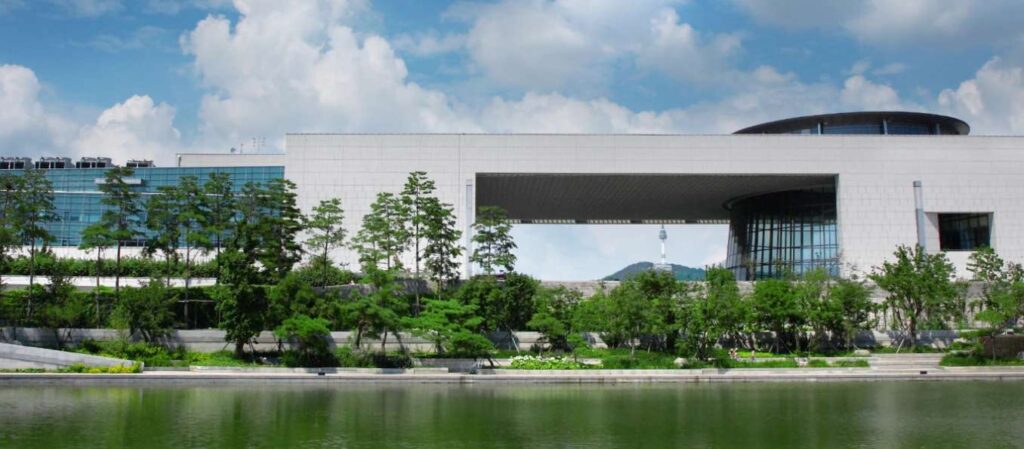
If you only have time for one museum in Seoul, make it this one. The National Museum of Korea in Yongsan tells the whole story of the country, from Stone Age pottery to Joseon paintings, and the permanent galleries are free to enter. You can see a 1,500-year-old gold crown, two famous Buddhist statues and a marble pagoda from 1348, all in one visit.
Last updated: October 23, 2026. Opening hours, closures and special exhibitions can change, so check the museum’s official English website before you go.
National Museum of Korea at a glance
- Address: 137 Seobinggo-ro, Yongsan-gu, Seoul
- Admission: Free for the permanent galleries and the Children’s Museum. Special exhibitions are free or paid depending on the show.
- Hours: Mon, Tue, Thu, Fri and Sun 9:30 am to 5:30 pm (last entry 5:00 pm). Wed and Sat 9:30 am to 9:00 pm (last entry 8:30 pm).
- Closed: January 1, Lunar New Year’s Day and Chuseok. The galleries are also closed on the first Monday of March, June, September and December.
- Nearest station: Ichon Station (Line 4 or the Gyeongui-Jungang Line), Exit 2.
Why this museum is worth your time
Korea’s national museum was founded in 1945 and moved to its current home in Yongsan in October 2005. By floor area it is often listed among the largest museums in the world, and its collection runs to hundreds of thousands of objects. Only a small share, around 15,000 pieces, is on display at any one time, so you will not feel buried. The galleries are laid out in a clear line from ancient times to the present, which makes it an easy way to understand the Korea you see on the streets today.
How to get there
Take the subway to Ichon Station and use Exit 2. From there, an underground passage and a short walk of roughly 300 meters lead to the museum’s main gate, usually about 5 to 10 minutes on foot. Public transport is the easier choice because parking is limited. Download a map and translation app before you arrive. Our guide to Essential Apps for Foreigners in Korea covers the ones that work best.
Six treasures to look for
- Silla gold crown. Dug up from the Hwangnamdaechong tomb in Gyeongju and dating to around the 5th century, it is one of the museum’s most famous objects. Jade comma-shaped ornaments hang from its branches. It is listed as National Treasure No. 191.
- Gilt-bronze Pensive Bodhisattva. A calm, smiling figure sitting with one hand lifted to the cheek. The museum has a dedicated, dimly lit room for these statues (the “Room of Quiet Contemplation”), where two famous examples, National Treasures No. 78 and No. 83, stand side by side. Go slowly here. It is one of the quietest spots in the building.
- Ten-story Pagoda from Gyeongcheonsa Temple. A towering marble pagoda built in 1348 and now standing indoors in the main hall. Look closely at the carved lions, dragons, lotus flowers and Buddhist scenes. It is National Treasure No. 86.
- Goryeo celadon. Jade-green pottery from the Goryeo period (918 to 1392). The openwork incense burner (National Treasure No. 95) shows how delicate the craft was.
- Joseon paintings. Look for the genre paintings of Kim Hong-do, who drew everyday scenes such as wrestlers and village workers. Works on paper are rotated to protect them from light, so ask at the information desk what is on view.
- Prehistoric and Three Kingdoms pottery. Comb-pattern pottery gives a sense of how long people have lived on this land.
What is inside the permanent galleries
The permanent exhibition is split into six areas: Prehistory and Ancient History, Medieval and Early Modern History, the Donation Gallery, Calligraphy and Painting, Sculpture and Crafts, and Asian Art. Floor plans are free at the entrance and the layout changes from time to time, so check the map when you arrive.
A simple plan for your visit
- 90 minutes (highlights): The gold crown, the Pagoda in the main hall, the Pensive Bodhisattva room and one gallery of Goryeo celadon.
- 2 to 3 hours (comfortable pace): Add the Joseon paintings, the Asian Art gallery and a break at the museum café.
- Half a day: Add a special exhibition and a walk around the outdoor Pagoda Garden, which is open from 7:00 am to 10:00 pm and needs no ticket.
Practical tips
- Visit on a Wednesday or Saturday evening. The museum stays open until 9:00 pm on those days, and many visitors find the evening quieter than midday. Last entry is 8:30 pm.
- Go early on weekends and holidays. The museum opens at 9:30 am, and special exhibitions can bring big crowds.
- Use the free services. Coat storage is on the west side of the main gate, and lockers are near the museum shop and Children’s Museum. Wheelchairs and strollers are available in the main hall.
- Traveling with kids? The Children’s Museum is free, but it runs on timed sessions and needs an advance online booking.
- Ask about English help. Audio guides and English materials may be available at the information desk, but this can change, so check on arrival.
- Wear comfortable shoes. The galleries are large, and you will walk a lot.
What to do nearby
- National Hangeul Museum. It sits just past the museum’s main gate, about 100 meters further on, and is a good stop if you are curious about the Korean alphabet. If Hangeul sparks your curiosity, try Korean Texting Slang: 15 Abbreviations You’ll See Everywhere to see how people use it today.
- Yongsan Family Park. A wide green park next to the museum, nice for a walk when the weather is good.
- War Memorial of Korea and Itaewon. Both are within walking distance or a short ride away.
- A cheap, quick meal. If you want a light lunch before or after, see our Korean Convenience Store Food Guide. In colder months, the Korean Street Food in Autumn & Winter guide will tell you what to look for.
Pair it with the rest of your Seoul trip
- Visiting in autumn? Check Korea Autumn Foliage 2026: Peak Dates & Best Places and Korea in November 2026: Festivals & Autumn Foliage Course.
- Still planning your entry? Read K-ETA in 2026: Do You Need It? before you book flights.
- Want company? Post in the Travel Buddies space to find someone to visit with, or share your photos in the Culture space.
Sources
Hours, closing days, fees, address and visitor services were checked on October 23, 2026 against the museum’s official English visitor page. Background facts come from the sources below. Please confirm anything time-sensitive on the official site before you visit.
- National Museum of Korea, official English site (visitor information, hours, closures, admission): museum.go.kr
- National Hangeul Museum, directions from Ichon Station: hangeul.go.kr
- Wikipedia, “National Museum of Korea” (history, collection size, National Treasure numbers): en.wikipedia.org
- Korea JoongAng Daily, report on the permanent exhibition of the two Pensive Bodhisattvas: koreajoongangdaily.com
- The Korea Herald, report on the “Room of Quiet Contemplation”: koreaherald.com
- Google Arts & Culture, “Explore National Museum of Korea”: artsandculture.google.com
Have you visited the National Museum of Korea? Tell us which object stayed with you, and share any tips for first-time visitors in the comments!